
D.C.’s Criminal Gang Statute To Be Tested

by jamison on September 3, 2010

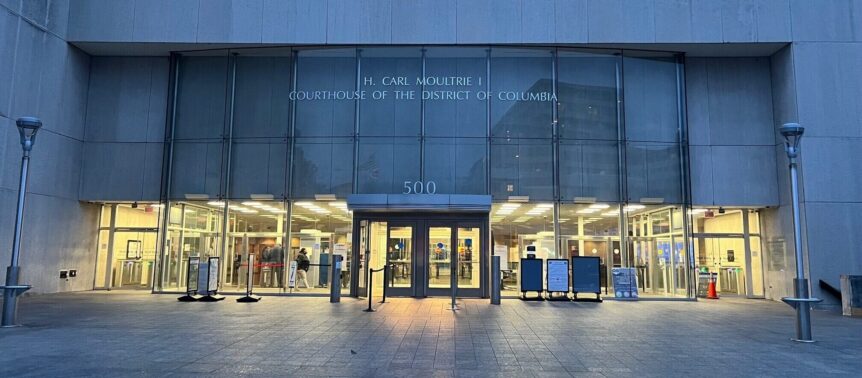
Trial begins today in D.C. Superior Court on a case that will test D.C.’s new criminal gang statute.  According to the Washington Post, five men who are allegedly members of the Todd Place crew are charged with killing a member of a rival group called the T Street gang.  In addition to first-degree murder, assault, obstruction of justice, and conspiracy, the men are also charged with violating the new statute.

Passed in 2007, D.C.’s Criminal Street Gang statute makes it a misdemeanor criminal offense to solicit, invite, or otherwise recruit another person to join what the person knows to be a “criminal street gang.”  “Criminal street gang” is defined as any association or group of 6 or more persons that either requires a crime of violence as a condition to membership or that perpetuates criminal acts as a part of its “purposes or frequent activities.”  The statute also provides that it is a felony punishable by up to 5 years in prison to “knowingly and willfully participate in any felony or violent misdemeanor” for the benefit of the gang.  D.C. Code § 22-951.

According to the D.C. Council member Phil Mendelson, the purpose of the statute is not only to hold the “actual perpetrator of a criminal offense accountable but also members of the offender’s gang who may have helped carry it out or benefited in some way.”  In addition to potential constitutional problems posed by the statute’s infringement on an individual’s right to assemble, the prosecution may have trouble proving gang membership, especially at the time of the offense.  The Post also quotes Laura E. Hankins of the D.C. Public Defender Service as saying:  “This definitional vagueness is easily subject to misinterpretation and abuse of enforcement.  A statute must be sufficiently specific to provide reasonable notice of what is legal or illegal, and the gang statute fails in this regard.”

{ 0 comments }

Courtesy of the solo practitioners at the ABA listserv Solosez, here are the top 15 signs that you have been working out of your home office, by yourself, for too long.

  1. You look forward to your dentist appointment.
  2. You’ve started talking to the cat. You don’t like cats.  You don’t have a cat.
  3. You look in the mirror and realize you have grown a beard.
  4. You look in the mirror and realize you have grown a beard.  And you’re female.
  5. A neighbor tells you he suspects you are in the witness protection program.
  6. The neighbors think your wife is having an affair with the FedEx guy.
  7. Your dry cleaner sends your wife a sympathy card.
  8. You start a video conference with a client and the client asks if everything is okay.  You glance down and realize you are still in your pajamas.
  9. Your clients start making “air quotes” with their fingers whenever they refer to your “office.”
  10. You consider your cable bill to be a business expense.
  11. You start referring to Starbucks as your “fancy office downtown.”
  12. You agree to let your kids watch “Charlie Bit My Finger” again.
  13. Your Solosez inbox has no unread messages.
  14. Your voice sounds all “froggy” when you answer the phone.  Clients wonder if they just woke you up.
  15. You try to schedule all of your appointments for the same day so you don’t have to get all dressed up TWICE in the same week.

{ 0 comments }

What Lawyers Put In Their Biographies; What Clients Actually Look For

August 31, 2010 Law Marketing/Networking

Courtesy of Matt Homann of the [non]billable hour:

Read the full article →

Sealing Criminal Records in D.C.

August 31, 2010 Other Criminal Offenses

While people charged with a crime tend to worry a lot about the case when it is still open, they try to put the whole experience behind them when the case is over.  First-time offenders may therefore fail to take advantage of an important option for minimizing the impact of the case on their futures:  [...]

Read the full article →

On Dealing With the Fallout From A Plea Bargain

August 27, 2010 Law Practice

In an ideal world, a criminal defendant would come to a decision on a plea offer based on nothing more than a calm, clear-headed, and dispassionate assessment of (1) the strength of the government’s case and (2) the strength of the defendant’s own case.  In real-life, other considerations intrude into the defendant’s decision.  People charged [...]

Read the full article →

On Why The Truth Doesn’t Matter At Trial

August 25, 2010 Evidence

One of my favorite episodes from the old T.V. show “All In The Family” involved a situation in which an African-American repairman came to the Bunker household to fix a kitchen appliance. Archie Bunker, the right-wing bigot, and his leftist, hippie son-in-law each remembered the incident differently, and the show began with two flashbacks in [...]

Read the full article →

On Respecting Your Elders

August 19, 2010 Criminal Law Bloggers

Scott Greenfield posted an entry the other day in which he described how Tannebaum had recently spent some time talking with an older, more experienced attorney.  “Why is it,” Greenfield asks, “that Brian, with all he’s accomplished, still listens to this lawyer with 64 years experience?  Why is it that so many inexperienced lawyers in [...]

Read the full article →

Erik Prince Meet Susan Burke

August 19, 2010 Miscellaneous

My wife Susan Burke heads to the United Arab Emirates this weekend to depose Blackwater Founder Erik Prince as part of one of her civil lawsuits against him. As reported in yesterday’s New York Times, Susan has brought suit against Prince on behalf of former Blackwater employees accusing Prince of defrauding the government. Susan has [...]

Read the full article →

On the Traffic And Quality of a Website

August 18, 2010 Criminal Law Bloggers

Talking about website traffic numbers is almost like talking about how much money you make. People can volunteer the information if they wish, but you normally don’t ask during the course of polite conversation. If your numbers are high, you can sound like you are boasting. If your numbers are low, well, people may not [...]

Read the full article →

D.C. “John School” Prostitution Diversion Program Discontinued

August 16, 2010 Other Criminal Offenses

The U.S. Attorney’s Office for D.C. has just discontinued the “John School” diversion program, effective August, 2010, for prostitution solicitation.  Prior to that time, people charged with soliciting a prostitute paid a fee of $300 and attended a one-day class on legal, health, and other risks associated with the offense.  While the prosecutor in Room [...]

Read the full article →